


 2026-02-10
The biggest challenge facing oxygen-enriched blast furnace operation is oxygen supply. Instability in the oxygen enrichment rate of blast furnaces at integrated iron and steel works has long been a critical issue, which is highly detrimental to the stability of blast furnace conditions and the performance of coal injection.
Practical Challenges
A Chinese iron and steel enterprise commissioned its ironmaking plant in 2009. However, a mismatch between steelmaking capacity and ironmaking production level resulted in an awkward situation: “one converter cannot consume all the hot metal produced, while two converters are still insufficient.” Consequently, oxygen enrichment for the blast furnace was far from satisfactory.
Oxygen generation capacity was slightly surplus during single-converter steelmaking, but barely adequate during dual-converter operation. As a result, oxygen supply to the blast furnace was intermittent, severely impairing furnace stability, the increase in coal injection rate, and the effectiveness of pulverized coal injection.
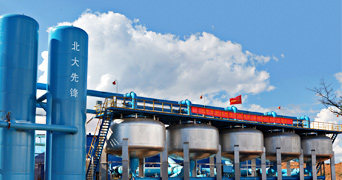
The plant once attempted to purchase liquid oxygen, but faced substantial cost pressure. To ensure a high and stable oxygen enrichment rate for the blast furnace in preparation for higher coal injection rates, the company conducted investigations and demonstrations, and selected the complete ZO-4000/90 VPSA oxygen generation unit provided by Beijing PKU Pioneer Technology Co., Ltd.
The unit was put into operation at the end of 2011. Production practice has proven that the system features a simple process flow, low investment, small footprint, compact structure, high automation, flexible and convenient operation, and low energy consumption. It also allows easy start-up and shutdown, reliable performance, and a low failure rate (nearly maintenance-free), fully meeting the oxygen enrichment demand of the blast furnace.
Technical Principle
Vacuum Pressure Swing Adsorption (VPSA) separates various gaseous components in air based on the pressure-dependent adsorption selectivity of adsorbents. The working principle is as follows:Air is slightly pressurized (above atmospheric pressure) and passed through a molecular sieve adsorbent bed. Since the adsorbent has a much stronger adsorption capacity for nitrogen than for oxygen, nitrogen in the air is selectively adsorbed, allowing oxygen to be separated and concentrated.
Once the molecular sieve is saturated with nitrogen, the pressure is reduced to desorb nitrogen, thereby regenerating the adsorbent for reuse.By alternately switching between two or more adsorbent beds, continuous oxygen production is achieved. Table1 lists the performance indicators of the ZO-4000/90 VPSA oxygen generation unit.
Table 1: Performance Indicators of ZO-4000/90 VPSA Oxygen Generation Unit
|
Item |
Unit |
Indicator Value |
|
Oxygen Purity |
% |
Adjustable: 80~93 |
|
Oxygen Delivery Pressure |
MPa |
≥0.6 |
|
Oxygen Temperature |
°C |
≤40 |
|
Oxygen Production Capacity |
Nm³/h |
5200~4200 (Adjustable with purity) |
Application Benefits
After the VPSA oxygen plant was commissioned, the blast furnace oxygen enrichment rate became essentially stable. The coal injection rate rose steadily (limited only by insufficient pulverizing capacity), and furnace conditions remained stable and smooth. Significant economic benefits were achieved, and the technical and economic indicators of blast furnace operation were notably improved, providing solid support for further increases in the coal injection rate.
The company is currently upgrading its coal injection system. The next-stage target is to increase the coal injection rate to 160–180 kg/tHM, while maintaining stable furnace conditions and a high replacement ratio. This will fully exploit the advantages of high-rate coal injection, intensify smelting, reduce the coke rate, effectively improve techno-economic indicators, and maximize economic benefits.
Oxygen-enriched blast is an essential prerequisite for increasing the coal injection rate and replacement ratio in blast furnaces. The application of high oxygen enrichment and high coal injection technology further improves the techno-economic performance of blast furnace ironmaking.
VPSA oxygen production technology, with its low energy consumption, further reduces oxygen costs and delivers remarkable economic benefits when applied to blast furnace ironmaking. It is therefore highly recommended for widespread promotion in the ironmaking industry.
The complete VPSA oxygen generation equipment supplied by Beijing PKU Pioneer Technology Co., Ltd. features a simple process, low investment, small footprint, compact structure, high automation, flexible operation, and low production cost, fully satisfying the production requirements of blast furnace ironmaking.
As a benchmark supplier in the field of gas separation for the iron and steel industry, PKU Pioneer has supplied large-scale VPSA oxygen units for blast furnace oxygen enrichment to nearly 100 iron and steel enterprises at home and abroad.
Going forward, PKU Pioneer will continue to take technological innovation as its driving force, helping more traditional manufacturing enterprises achieve capacity fulfillment, energy conservation, and carbon reduction, and jointly building a new ecosystem for green industrial development.

